
Here’s the Secret Phrase to Turn Your Kid Into an Amazing Student
My 5-year-old struggles when she makes mistakes. Just a hunch, but I think it might have something to do with her mother being a perfectionist. Or maybe it’s just the nature of my child’s own personality.
But watching my child be so incredibly hard on herself gives me a renewed sense of urgency to get a handle on my own perfectionist tendencies.
She’ll say things like:
- “I’m never going to learn how to read.”
- “Everyone else is better than me.”
- “I’m the worst kid in the world.”
That last one is like an ice-cold knife sliding into my mama heart.
Ready for a solution now? Get these fun coloring posters for your child to teach them the power of hard work and sticking with a problem.
An Eye Opener
The other night as I was tucking my child in, I asked: “What makes someone smart?”
“Their brain,” she said.
I laughed. “That’s a good point.”
Then I asked: “What about your baby sister? Is she smart?”
“No.”
I raised one eyebrow. “How will she get smart?”
“By learning things.”
“Yes,” I agreed. “And by making mistakes, right?”
She nodded.
We were both quiet for a few seconds. I thought of earlier in the day when she said she’d never learn to read. In response, I picked out an easy reader book and sat down with her. She read the whole thing, needing help on just a handful of words.
She pulled the covers up over her shoulders, snapping me out of the memory.
I asked: “What about you? Are you smart?”
A shy little smile. “Yes.”
“Are you as smart as you’ll ever be?”
“No.”
I smiled. “How will you get smarter?”
“I’m going to learn more things.”
“And make mistakes, right?”
She nodded.
One day, I know I’ll get an eye roll instead of a nod, but in the meantime I’ll gladly brainwash the perfectionism out of her.

There Are Two Kinds of People in the World
Our conversation that night sparked something for me.
A few years ago, I volunteered as a mentor to a small group of girls in a second-grade classroom.
In the volunteer training, the educators running the program taught us a concept I’d never heard before: fixed versus growth mindset.
Children who have a fixed mindset believe that you are as smart as you’ll ever be. You can’t change how smart you are, no matter how hard you try. And you can’t change your personality or how creative you are.

But children with a growth mindset believe that if you work hard, you can become smarter. These kids thrive on challenge. Whereas fixed-mindset kids see failure as evidence of not being smart, growth-mindset kids see failure as an opportunity for growing. In fact, they don’t even see it as failure. They see it as LEARNING.
Can you take a guess which kids are most successful in school and in their careers later in life? Which kids have the greatest capacity for happiness?
More than 20 years of research shows that the key to success in school and life is having a growth mindset. In other words, if you believe that trying hard will make you smarter, it will.
However, if you believe that nothing you do will change how smart you are, it’s a self-fulfilling prophecy. What’s more, these fixed-mindset kids don’t enjoy the learning process. Their mindset even drives them to lie about their school performance in order to maintain the perception that they are smart. They simply can’t handle mistakes.
“In one world, effort is a bad thing. It, like failure, means you’re not smart or talented. If you were, you wouldn’t need effort.
In the other world, effort is what makes you smart or talented.”
Related: One Powerful Word That Will Stop Negative Self-Talk in Kids {Printable}
In the Words of a Genius
This idea may be hard to accept. The whole concept goes against what a lot of us have believed our whole lives. Myself included.
I’ve always thought: You’re either smart, or you’re not.
In the words of Ron White: “You can’t fix stupid.”
But here’s what another famous person had to say on the subject:
“It’s not that I’m so smart, it’s just that I stay with problems longer.” – Albert Einstein
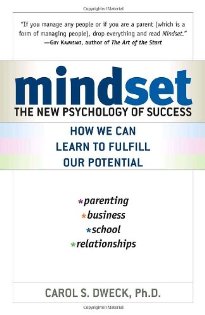
If you think Einstein was just being humble, you can read this book† to see the years and years of research that proves his point. From an article about the book:
“This growth mindset is based on the belief that your basic qualities are things you can cultivate through your efforts. Although people may differ in every which way – in their initial talents and aptitudes, interests, or temperaments – everyone can change and grow through application and experience.
Do people with this mindset believe that anyone can be anything, that anyone with proper motivation or education can become Einstein or Beethoven? No, but they believe that a person’s true potential is unknown (and unknowable); that it’s impossible to foresee what can be accomplished with years of passion, toil, and training.”
Well, duh. As a parent, of course you believe that if your child works hard, they can be anything they want to be.
But the problem?
Our actions as parents don’t always support this important growth mindset.
Here’s What We’re Doing Wrong
Have you ever told your kid they’re smart? I sure have.
And we’re not alone. According to one survey, 85 percent of American parents think it’s important to tell their kids that they’re smart.
But we need to stop, and here’s why.
Telling your child “You’re smart” is playing right into the fixed mindset.
In just one of the many studies that shows what happens when you praise your child by saying they’re smart, the researchers studied fifth-grade students:
The researchers would take a single child out of the classroom for a nonverbal IQ test consisting of a series of puzzles – puzzles easy enough that all the children would do fairly well. Once the child finished the test, the researchers told each student his score, then gave him a single line of praise. Randomly divided into groups, some were praised for their intelligence. They were told, “You must be smart at this.” Other students were praised for their effort: “You must have worked really hard.”…
Then the students were given a choice of test for the second round. One choice was a test that would be more difficult than the first, but the researchers told the kids that they’d learn a lot from attempting the puzzles. The other choice…was an easy test, just like the first. Of those praised for their effort, 90 percent chose the harder set of puzzles. Of those praised for their intelligence, a majority chose the easy test. The “smart” kids took the cop-out.
But why?
“When we praise children for their intelligence,” [researcher Carol Dweck] wrote in her study summary, “we tell them that this is the name of the game: Look smart, don’t risk making mistakes.” And that’s what the fifth-graders had done: They’d chosen to look smart and avoid the risk of being embarrassed.
In a subsequent round, none of the fifth-graders had a choice. The test was difficult, designed for kids two years ahead of their grade level. Predictably, everyone failed. But again, the two groups of children, divided at random at the study’s start, responded differently. Those praised for their effort on the first test assumed they simply hadn’t focused hard enough on this test. “They got very involved, willing to try every solution to the puzzles,” Dweck recalled. “Many of them remarked, unprovoked, ‘This is my favorite test.’?” Not so for those praised for their smarts. They assumed their failure was evidence that they weren’t really smart at all. “Just watching them, you could see the strain. They were sweating and miserable.”
Having artificially induced a round of failure, Dweck’s researchers then gave all the fifth-graders a final round of tests that were engineered to be as easy as the first round. Those who had been praised for their effort significantly improved on their first score – by about 30 percent. Those who’d been told they were smart did worse than they had at the very beginning – by about 20 percent.
Telling your kid they’re smart stresses them out. It shifts their focus to getting and keeping that label of “smart.”
And when they’re focused on labels instead of learning, they don’t learn as well, they don’t enjoy the learning process, and they actually do worse on their schoolwork because of it.
Okay, Okay! Tell Me What to Do Instead!
If you’re like me, after reading this you’re all “Wait, whaaa? Not tell my kid they’re smart? That’s just MEAN!”
And yes, you may feel like a meanie at first.
But the secret to turning your child into an awesome student and setting them up for a life of success is to praise their effort, not the outcome.
Every time you feel the urge to say “Wow, you’re so smart” or “You’re really good at math,” say this magic phrase instead:
“You worked really hard.”
That’s all.
Just comment on how much effort your kid put into what they’re doing. Add a “Wow” at the front if you want to kick it up a notch. (But if you start to feel like a robot always saying that one phrase, you can keep your encouragement fresh with these 125 encouraging phrases for kids.)
Over time, your child will learn that it’s okay to struggle. That it’s okay to make mistakes and learn from them. And even better, they’ll learn that it’s fun to challenge yourself to learn new things.
Get Your Copy: 9 Best Mindset Posters That Will Inspire Your Child to Keep Trying
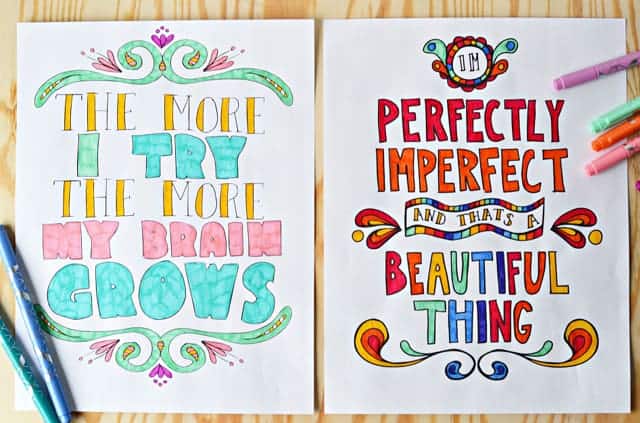
Print These Coloring Posters to Change Your Kid’s Mindset
I’ve tried countless parenting techniques to encourage a growth mindset in my kids – some of them total duds.
But I wish I’d created these special mindset posters much earlier because the results have been fast and impressive with my grade-schooler and my preschooler. (Even my toddler repeats the growth mindset mantras she hears from her older sisters!)
Thanks to these mindset posters, my kids have internalized powerful, positive mantras to remind them that hard work and sticking with a problem will help their brains grow – and will help them become the people they want to be. (Check out the science behind these growth mindset posters that makes them so powerful with kids.)
Get your own set of mindset posters here, and you’ll unlock your child’s true potential for working hard, not giving up, and learning from their mistakes.
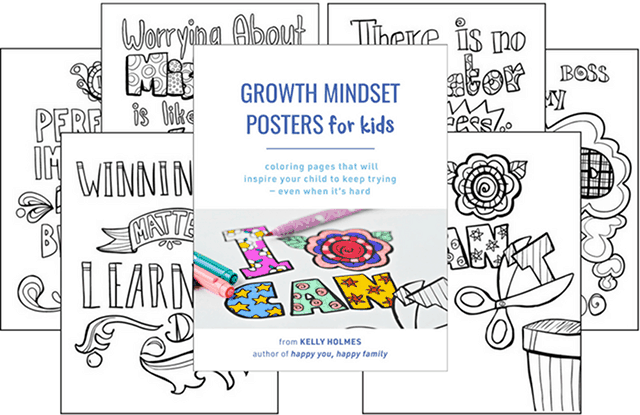
Get yours now: 9 Best Mindset Posters That Will Inspire Your Child to Keep Trying
Want More?
If you want to nurture a growth mindset in your child, here are our most popular resources:



Your Turn
Which mindset do you have? What about your kids? Leave a comment to share!
Social media photo by woodleywonderworks.


Great post! I am trying to be a mistake-making grower, but I am absolutely a safe on the sidelines kind of girl by nature! Thanks for sharing this at Big Hair and Books!
Rosemond, I’m glad you enjoyed this post! I’ve been using this phrase with Abby more and more – it’s definitely a process of re-training myself. But I can definitely tell a difference with her. She’s starting to take pride in things that are hard work for her brain!
Loved your article! Thank you for writing that.
Love the article! You must have worked hard on it. :-) The number of ads on your blog is distracting though.
wow is THIS ever ‘right on’!!! I was a straight A student, well behaved kid, and I was always told how “smart” or “good” I was. (or how I was “too smart NOT to do this or that” THAT’s a bad one too :( ) Anyway, yesterday I ended up breaking down to my mom about how I felt that I was always pressured to be “good enough” and when I DIDN’T measure up to that said “ideal” I felt completely WORTHLESS. This is a good post. It applies to ALL of life eve, not just schooling! :)
Saying “you’re smart” is such a hard habit to break. I notice that my kids’ grandparents use this phrase all the time with my kids, and it makes me cringe. I’ll pass along this suggestion! Thank you for giving us a simple alternative.
I have always told my children that while they are naturally smart, I am most proud of them for their hard work. (and their loving hearts, kindness, etc)
Love this. Thank you. “Good job” is I think along the same vein and a phrase I think needs to pretty much be eliminated from our vocabulary as well. I have a 2.5 year old and appreciate articles that challenge us to communicate more effectively with her. I love your blog, and to be honest with you, I find most “mommy blogs” incredibly annoying. But I find yours refreshingly un-annoying. ;) So, good job! (…get it?)
Some things need to be as perfect as possible, some do not. Blessed is the person who can tell the difference.–Ron Cade
Great article. Please help me with tits though. My second grade daughter is dyslexic and hates school. What do you say hen she constantly says, I’m so dumb. Everyone reads better than me. I’m so dumb at math. I’m in the lowest group……i have been counteracting her saying she’s dumb all the time with telling her she’s smart……please advise
Hi Nicole, I don’t know where you are now at in your journey, I see your post is over a year old. But still I wanted to share that I have a daughter with lots of challenges and one suggestion we received from psychologist was to help her to realize her path is different, but everyone learns differently and that she is learning and doing it at her pace. We recognize her effort and we tell her how proud we are of the effort she does at doing her work at school because we know it is hard for her. I don’t know what the results will be but I feel she’s feeling a bit more confident and relaxed. One phrase we use is practice, practice makes us better and she has seen the outcome with some things like the monkey bars, with constant practice she became really good at that and we try to bring that example to other things that are hard for her. I hope things are going well for you and your daughter. Erika
Hi Nicole,
I got a really amazing tip from an ADHD and learning difficulty expert, which was to focus on things that the child IS “good at” / loves doing and exels at. Let them do more of that, which will make them feel competent and from this mindset they become “braver” to try other things.
Hope that helps!
Heidi
Similar to “The Nurtured Heart Approach” to parenting…which is all about being specific in regards to praise, and finding the greatness in every child. Thank you for writing and sharing this!
That’s a very interesting approach… I’ve been told I’m smart and I grow up being lazy (I have to admit, honestly).
I hope to raise my kids eager enough to respect the hard work.
Great post and thank you for the printable! We’ve been working on the growth mindset and I think this is a great exercise to do with my girls. :)
I love your one-stop phrases, Kelly. My daughter is a violinist. She is getting very good but really struggles with making mistakes. She would rather move on in a huff than spend the 2 minutes and 10 repetitions it would take to fix them. I’ll be printing this coloring page for her and stapling it to her violin. Just kidding about the stapling. But she will be getting this. :) Thanks!
Wow, Kelly. This is pure gold. Thank you so much for what you are doing with this blog. Not many other things that are as important as helping countless moms/dads with these very tricky but lasting aspects of parenting. I thank God for ‘your efforts’ ?? and pray He will bless you for it!
Hi Kelly, I’m wondering if there is an equivalent for building kindness in our children. My three year old is not showing a lot of kindness at the moment. I’ve been been saying “you’re kind” or “our family is kind” but it isn’t having much effect. When she shows kindness, I can say “you cared about that person”, but I don’t know what is helpful to say when she chooses not to be kind – what the equivalent of the high five and “you’re learning” in this article is. Any ideas?
This is not a place for me to post photos. But, my Jaw dropped. You would see why too. My grandson, Is the spitting image of the little guy in the photo, right down to the dejected head posture and the forehead grabbing.
Two out of my three grandsons have precisely the outlook described in this article.
Thank you, thank you for your insightful observations, and excellent coping strategy.
I can’t wait to try it out this tactic today after school during homework time. .
What would you say to a 5th grader that has a C in Math (his best subject)? I made the mistake of saying “you are smart. you can do better”. That didn’t do anything and he still has a C in Math. He just doesn’t pay attention and doesn’t show his work.